// calculator
Ecommerce working capital calculator with the cash conversion cycle
Work out your working capital, current and quick ratios, and the cash conversion cycle from days of inventory, sales and payables. Free, in your browser.

David LindahlFounder of Keel HQ, and runs a DTC brand on it
Published Last verified
// tl;dr
Working capital is current assets minus current liabilities. The cash conversion cycle adds the days your cash sits in stock and in receivables and takes off the days suppliers let you wait: the lower it is, the less cash your growth needs. Enter your balance-sheet figures to see both. Nothing leaves your browser.
// calculator
$78,000
Working capital: $158,000 of current assets less $80,000 of current liabilities.
| Operating working capital (receivables + inventory − payables) | $65,000 |
|---|---|
| Current ratio | 1.98 |
| Quick ratio (cash + receivables) | 0.85 |
| DIO: days of inventory | 94.0 days |
| DSO: days of sales in receivables | 12.2 days |
| DPO: days of payables | 44.2 days |
| Cash conversion cycle (DIO + DSO − DPO) | 61.9 days |
A standalone estimate from the balance-sheet figures you type, not Keel HQ's numbers. Balances are a snapshot, so a seasonal business can read very differently a month later.
The formulas
working capital = current assets − current liabilities
DIO = inventory ÷ (cost of goods sold ÷ days in period)
DSO = receivables ÷ (revenue ÷ days in period)
DPO = payables ÷ (cost of goods sold ÷ days in period)
cash conversion cycle = DIO + DSO − DPO
quick ratio = (cash + receivables) ÷ current liabilities
Operating working capital is receivables plus inventory minus payables: working capital without cash and debt, the part your sales cycle ties up. The days use the revenue and cost of goods for the period you enter and balances at its end. The formulas for the cash conversion cycle follow the standard definitions; some sources divide payables by purchases instead of cost of goods sold.
Worked example
Over a year, a brand has $600,000 of revenue and $330,000 of cost of goods. It holds $48,000 in cash, $20,000 in receivables, $85,000 of inventory and $5,000 of other current assets, against $40,000 of payables, $30,000 of short-term debt and $10,000 of other current liabilities. Current assets are $158,000 and current liabilities $80,000, so working capital is $78,000 and the current ratio 1.98. Days of inventory are 94.0, days of sales 12.2 and days of payables 44.2, so the cash conversion cycle is 61.9 days.
What this does not do
It is a standalone estimate from the totals you type, not your books and not Keel HQ's numbers. A balance is a snapshot, so a seasonal business can read very differently a month later, and averaging the opening and closing balances gives a steadier figure. It does not model seasonality, long-term debt or what the cycle will be after a change.
When to use it
Before a large purchase order or a growth push, to see how many days of cash the plan will tie up.
Questions
- What is working capital?
- Current assets minus current liabilities: the cash you have, plus what you are owed and what sits in stock, less what you owe within a year. It is the cushion that pays for day-to-day operations.
- What is the cash conversion cycle?
- The days between paying for inventory and collecting from the sale: days of inventory plus days of sales in receivables, minus days of payables. A shorter cycle frees cash; a negative one means suppliers fund your stock.
- How are DIO, DSO and DPO calculated here?
- Days of inventory is inventory divided by cost of goods sold per day. Days of sales is receivables divided by revenue per day. Days of payables is payables divided by cost of goods sold per day, the usual approximation when you do not have purchases handy.
- What is the quick ratio?
- Cash and receivables divided by current liabilities. It leaves inventory out because stock is the slowest current asset to turn into cash.
- Why can my numbers differ from Keel HQ's?
- Keel HQ measures days of payables from the payment dates on your purchase orders, not from a payables balance, and its days of sales count your Shopify payout lag. A form that takes balance-sheet totals uses simpler definitions, so treat this as an estimate.
- Does Keel HQ store what I enter?
- No. The calculator runs in your browser, and nothing you type is sent anywhere.
// how keel hq does this
Know your position. Never be surprised.
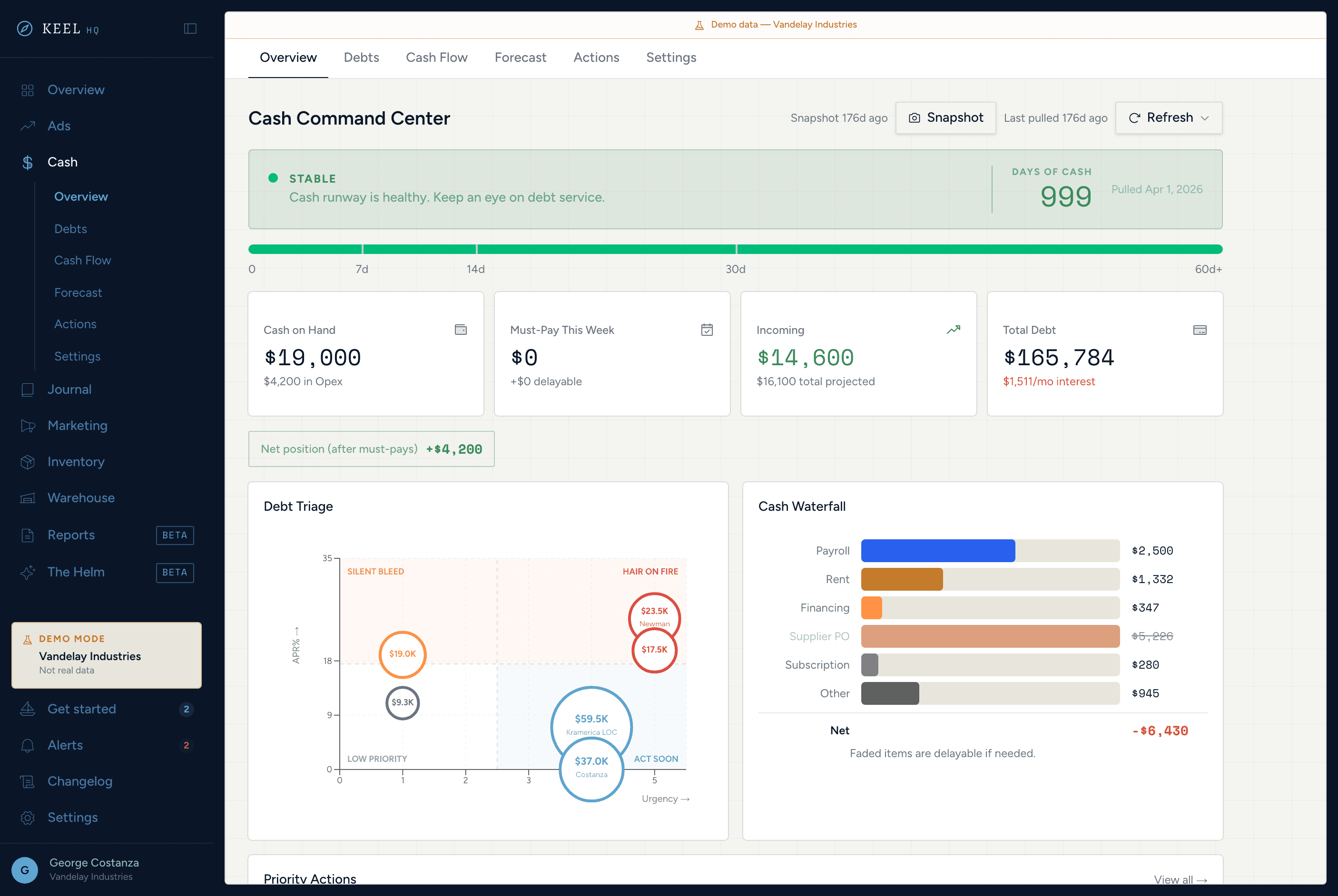
Runway days, debt stack, a 14-week rolling forecast with scenario sliders, and auto-generated action items — all without a spreadsheet.
See cash command center in Keel HQKnow what to reorder and what to stop buying.
From ABC grading to sell-through curves, product pipeline, margin modeling, and return tracking — inventory ops without the spreadsheet.
See inventory in Keel HQ
// sources
- Cash conversion cycle, Wikipedia · accessed
- Working capital, Wikipedia · accessed
- Quick ratio, Wikipedia · accessed